
HISTORY AND ORIGIN OF SAN LUIS
The town of San Luis formerly called “Balibago” was among the southern barangays of old Taal. Accordingly, it was named Balibago because of its proximity to Balibago River which separates San Luis from Taal, and the river was so called because of its ever-changing course which is vernacular means “pabago–bago”.
The early inhabitants clamored independence from Taal. The secession movement reached its peak leaving the Municipal Government of Taal no alternative but to divide Taal into three: one division so-called San Genaro, now Lemery; the second to be called Balibago, now San Luis, and the third remain Taal. Unfortunately, the agricultural economy to Balibago does not warrant self-sufficiency, hence Balibago lost her independent status and once again, in 1904, was integrated to mother town Taal.
Nourished by strong desire and determination, the independent ideals remain among the inhabitants, Low economy was never a barrier for them to continue the struggle to regain the lost independence. Pioneered by Aquilino Badillo, Mariano Diokno, Ambrocio Hernandez, Anselmo Lasala, and Andres Medina, nourished by the brilliance of Justice Ramon Diokno and Atty. Vicente Illustre whose contribution, we people of the present generation acknowledge; the inhabitants succeeded in their fight for independence. Hence, on February 2, 1918, the independence of San Luis was regained.
Renaming of the town
When San Luis becomes a town on August 25, 1861, the barangay name Balibago remain. However, when February 2, 1918, the town regains its independence from the old town of Taal, it was named San Luis to commemorate the first time of its secession from Taal and become an independent town on August 25, 1861, on the feast day of Saint Louis.
Location
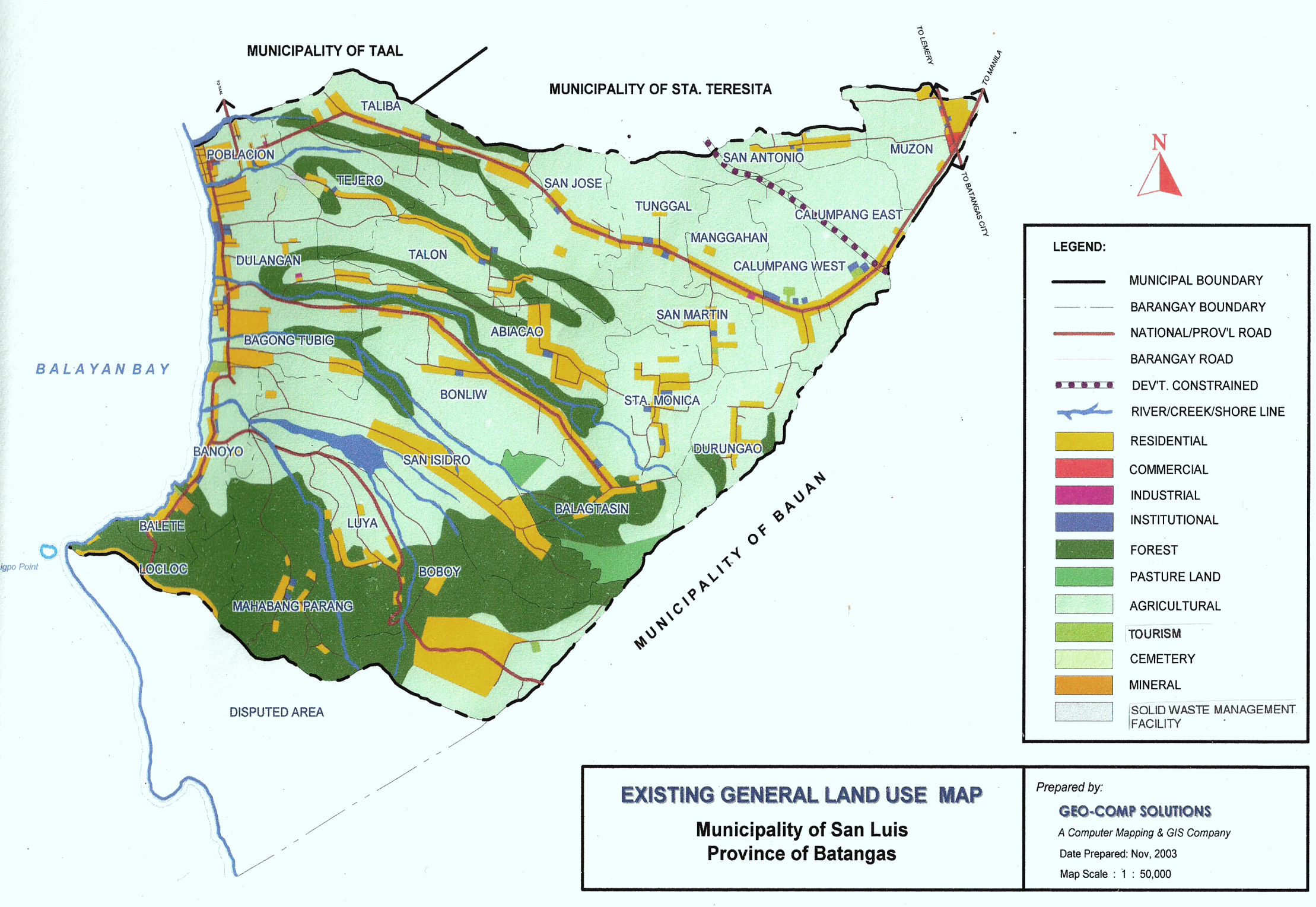
The municipality of San Luis has slightly slope terrain located at the foot of the mountain of Bauan in the south. It is bounded by the municipalities of Taal and Sta. Teresita on the North, and by Alitagtag on the east, while on the west by Balayan Bay. The town is 27 kilometers from the capital of the province and 119 kilometers from Manila.
Physical characteristics
A. Climate
The rainy season starts on June and ends on November. When December comes, people can experience a very cool dawn which last until the early days of February. The summer season starts on the month of February up to the end of May.
B. Topography
San Luis is a hilly town, characterized by thick forest and numerous springs. Only the town proper and other four (4) barangays constituting the low land along the seashore namely; Dulangan, Bagong Tubig, Banoyo and Balite. The other twenty one (21) barangays are situated in the hills and mountains of San Luis. Barangay Boboy, Mahabang Parang and Locloc are the highest elevated barangays located in the peak of the mountain in the southern portion of the town.
C. Soil
San Luis is a typical agricultural municipality. Almost ninety three percent (93%) of the total land area is devoted to agriculture due to its productive loam which is present in every part of the municipality. Existence of sandy soil in the low land especially in the shoreline and riverbanks are also noted.
